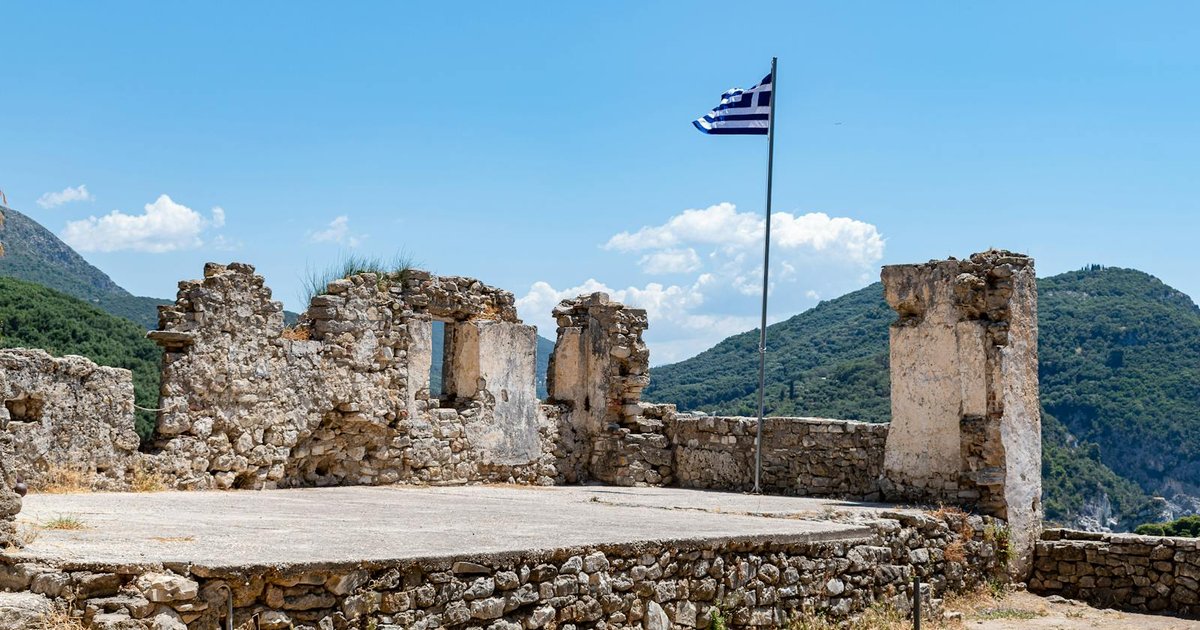
The question that comes up most often at the breakfast table in our beach house, after a day in Corfu Town, is almost always the same: "Why doesn't it look like the other Greek islands we've been to?" Fair question. The short answer is that Corfu spent four hundred years under Venice while the rest of Greece spent four hundred years under the Ottomans. Everything flows from that single fact.
What follows is the version we give our guests over coffee — a short, honest history built around the bits that will actually make your Old Town walk more interesting.
Ancient Corcyra
The island's first act was as Corcyra, a Corinthian colony founded around 734 BC. By the 5th century BC it had one of the largest fleets in the Greek world, and its 433 BC naval battle with Corinth helped trigger the Peloponnesian War. The ancient city sat on the Kanoni peninsula — where Mon Repos Palace now stands — and the famous Gorgon Pediment in the Archaeological Museum came from a temple there. If you're doing the Mon Repos day trip, you're walking through 2,500 years of continuous history.
The Byzantine Centuries (337 – 1267)
Corfu was Byzantine for eight centuries — a front-line island between Constantinople and whichever western power was attacking that decade. Goths, Vandals, Saracen pirates, Normans. The twin peaks of what is now the Old Fortress were fortified as a refuge. Angelokastro, the mountain stronghold in the northwest, served the same purpose. Most guests visit the Old Fortress without realising they're walking on Byzantine foundations.
Venice Arrives (1386)
After a short period of Angevin rule, the Corfiots — worried about the rising Ottoman threat — invited Venice in as protector. Venice stayed for 411 years. Longer than the entire history of the United States to date.
What the Venetians Built
The Old Fortress and New Fortress (both rebuilt by Venice), the Old Town's shuttered streets, the Kantounia — narrow alleys between tall buildings, very recognisably Italian. When you walk into the Old Town from the Spianada, you are walking into what was essentially a miniature Venice-in-the-Ionian. It survived four major Ottoman sieges (1537, 1571, 1573, 1716) without falling.
The Olive Trees
Venice paid a gold coin for every hundred olive trees Corfiots planted. Four million trees later, the island is covered in them — many of the oldest, most gnarled specimens are still producing oil today, five hundred years on. The groves you drive past on the way inland from Acharavi are a direct Venetian inheritance.
The French Interlude (1797 – 1814)
Napoleon dissolved Venice in 1797 and Corfu passed to France. Short period, lasting impact. The French burned the Libro d'Oro — the official register of noble families — and laid out the Spianada esplanade and the Liston, the elegant arcaded street modelled on Paris's Rue de Rivoli. If your Corfu Town dinner involves sitting under the Liston arches with a spritz, you are sitting inside a Napoleonic project.
The British Protectorate (1815 – 1864)
After Napoleon, the Congress of Vienna put the Ionian Islands under British protection for nearly fifty years. This is the period that gave Corfu cricket.
Palace of St Michael & St George
The grand neoclassical building at the north end of the Spianada, built 1819–1824 as the Lord High Commissioner's residence. Now the Museum of Asian Art — worth a visit even if you weren't planning on one, if only to see the interior.
Mon Repos Palace
Built in 1828 by Sir Frederick Adam as a summer home for his Corfiot wife. Later the Greek royal family's summer residence, and the birthplace of Prince Philip, Duke of Edinburgh, in 1921.
Cricket & Tsitsibira
Cricket is played on the Spianada every weekend in season — Corfu is the only place in Greece where this is true. Tsitsibira, the local ginger beer, was introduced by British soldiers and is still brewed locally. The brass marching bands you hear at every festival trace back to British regimental tradition.
Union with Greece (1864)
On 21 May 1864, after decades of Corfiot political agitation, the Treaty of London ceded the islands to Greece. The date is still a public holiday here. The British left behind a good road network, the Adam aqueduct, and the impressive administrative machinery that ran the island until independence.
The Twentieth Century
Italian was still spoken by the Corfiot upper classes into the 1920s. The Second World War brought Italian then German occupation; a 1943 bombing raid destroyed parts of the Old Town, and the Jewish community — present since Venetian times — was almost entirely deported. A small memorial in the Old Town commemorates them, and it's worth walking to.
In 2007 the Old Town was inscribed as a UNESCO World Heritage Site. The inscription cites the unique Venetian-French-British ensemble you see when you walk it.
Host's Tip
If you want one book to read on the plane, Lawrence Durrell's Prospero's Cell is the short, literate one. Gerald Durrell's My Family and Other Animals is the charming one. Both were written from a house on the east coast near Kalami — you can still see the White House from the water.
What to See on a History Day
A full history day from our beach house near Acharavi goes: drive to the Old Town (50 minutes), walk from the Old Fortress through the Spianada to the Liston, Palace of St Michael & St George, lunch under the arcade, then either Mon Repos (south of the Old Town) or the Archaeological Museum for the Gorgon Pediment. Back for the evening swim.
★ Rent a Car with Herbie
Our recommendation for getting around Corfu. Delivered to the beach house, picked up wherever you leave it. Reliable, local, and fairly priced.
Book a car →Luggage and Logistics
If you're combining your history day with arrival or departure, Lock and Walk near the Old Port keeps bags safely while you walk the city unencumbered.
Stay With Us
If you'd like to mix Venetian history days with quiet mornings on a northern beach, our beach house in Acharavi is the right base — 50 minutes from the Old Town, ten minutes from Kassiopi. For guests who'd rather wake up inside the history itself, the town house in the Old Town puts you a two-minute walk from the Liston.
Read Next
The Achillion Palace guide is the natural next step — Empress Sisi's late-19th-century retreat brings the story up to modern times. And our Old Town walking guide turns this history into an actual walking route.